A Clear Handbook for Non-Residents Owning Real Estate in Japan
Executive Summary
If you live outside Japan and own rental property here, an important tax deadline arrives every March.
Many international property owners pay more tax than necessary simply because they do not file an annual return to adjust the tax their tenant withheld during the year.
For income earned in 2025, the filing period runs from February 16 to March 16, 2026. (The deadline is usually March 15, but since that falls on a Sunday in 2026, it moves to Monday.)
Filing your return ensures that your rental income is taxed correctly and, in many cases, allows you to recover excess tax that was withheld.
1. Why Is Tax Taken From My Rent?
Japan uses a “withholding tax” system for landlords who live overseas.
If your tenant is a company, or an individual using the property for business purposes, they are required to withhold 20.42% of the rent and send it directly to the National Tax Agency.
The key point is that this 20.42% is calculated on your total rent (gross income). It does not take into account your expenses such as repairs, management fees, or depreciation of the building.
Because the tax is taken from the full rent amount, the amount withheld is often higher than your final tax liability.
2. How Filing a Tax Return Can Save You Money
When you file a tax return (Kakutei Shinkoku), you report your actual profit to the tax office.
Your taxable profit is:
Rent – Expenses = Net Profit
The tax office then calculates your tax based on that net amount, not on the full rent.
In many cases, the final tax calculated on your net profit is lower than the 20.42% that was originally withheld. If so, the difference is refunded to you.
A Practical Example
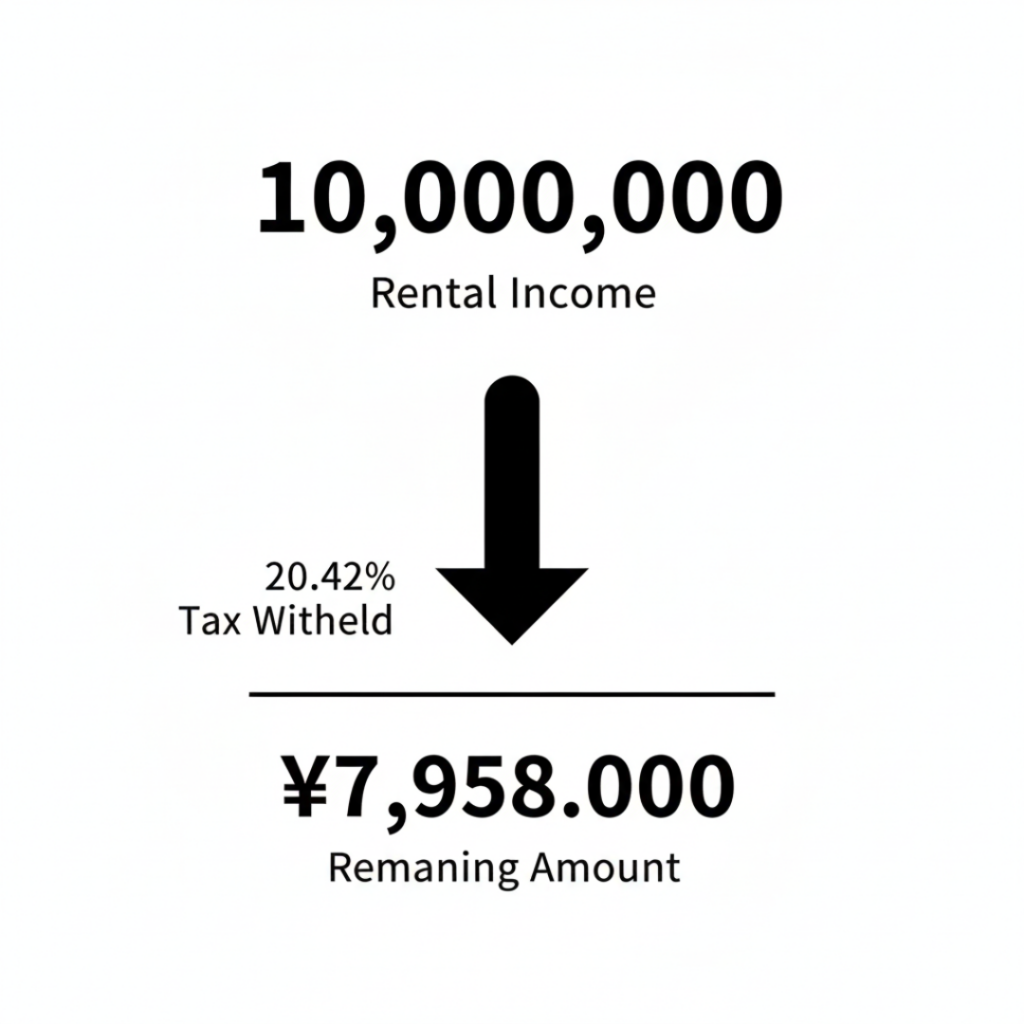
Let’s imagine a rental property with the following 2025 results:
- Total Rent Received: ¥10,000,000
- Tax Already Withheld (20.42%): ¥2,042,000
Now let’s look at the actual expenses:
- Building Depreciation: ¥2,500,000
- Property Management Fees: ¥500,000
- Repairs & Cleaning: ¥300,000
- Fixed Asset Tax: ¥400,000
- Mortgage Interest: ¥300,000
- Total Expenses: ¥4,000,000
Net Taxable Profit: ¥6,000,000
The tax on a ¥6,000,000 profit is typically lower than the ¥2,042,000 already withheld. By filing the return before the March 16 deadline, you may receive a meaningful refund.
The exact amount depends on your total income and tax bracket, but the difference can be substantial.
3. What Expenses Can You Deduct?
To reduce your taxable income, you must report the costs directly related to owning and operating the property.
Common deductions include:
- Management Fees – Payments to your property manager
- Building Insurance – Fire, earthquake, or liability insurance
- Repairs & Maintenance – Fixing equipment, plumbing, repainting, etc.
- Loan Interest – Only the interest portion (not the principal repayment)
- Fixed Asset Tax – Annual property tax paid to the city
- Depreciation – A yearly deduction based on the building’s value and structure
Depreciation is often one of the largest deductions. Even though it is a non-cash expense, it reduces taxable income and can significantly lower your final tax bill.
4. The Five-Year “Recovery” Rule
If you missed filing in previous years, it may not be too late.
In Japan, you can generally file a return and claim a refund for up to five years after the original deadline.
If you have been paying 20.42% withholding tax but have not filed returns for 2022, 2023, or 2024, you may still be able to recover overpaid tax.
Reviewing past years can improve your overall investment return without changing anything about the property itself.
5. Selling Your Property in the Future
When a non-resident sells Japanese property, the buyer usually withholds 10.21% of the total sale price as a provisional tax payment.
However, tax should be calculated on your profit (capital gain), not the full sale price.
To reconcile the difference and recover any excess withholding, you must file a tax return for that year.
Maintaining a consistent filing history helps make the refund process smoother and reduces unnecessary questions from the tax office.
6. Why Banks Review Your Tax Returns
If you plan to expand your portfolio or refinance your property, Japanese banks will usually ask to see your recent tax filings.
When assessing loan applications, banks typically review the last two to three years of tax returns.
Consistent and accurate filings show that:
- Your rental income is properly reported
- Your property is managed responsibly
- You are in good standing with the government
This can improve your credibility when negotiating loan terms.
7. Common Pitfalls to Avoid
While the system is straightforward, non-resident owners sometimes make avoidable mistakes:
Mixing Personal and Property Costs
Only expenses directly related to the rental property are deductible. Personal travel to Japan is usually not deductible unless it is clearly for property business.
Not Understanding “Business Scale” Rules
Owners of multiple properties (often five houses or ten units) may qualify for additional deductions under special filing methods. Smaller-scale landlords do not automatically receive these benefits.
Ignoring the Tax Representative Requirement
Trying to manage tax matters from overseas without a local representative can result in missed notices, delayed refunds, or penalties.
8. The Tax Representative (Nozei Kanrinin)
Because you live outside Japan, communication with the tax office can be difficult. For this reason, non-residents are required to appoint a Tax Representative in Japan.
Your representative:
- Receives official mail from the tax office
- Submits your annual tax return
- Arranges for your refund to be received in a Japanese bank account
Many international owners choose a licensed Tax Accountant (Zeirishi) for this role to ensure everything is handled correctly.

Frequently Asked Questions (2026 Filing Season)
You will need your annual rent statements, management reports, repair receipts, property tax bill, and (if applicable) your mortgage interest statement.
The filing period runs from February 16 to March 16, 2026. Preparing your documents in January or early February allows sufficient time for accurate filing.
If you are owed money, refunds are typically processed within one to two months after submission.
Japan has tax treaties with many countries, including Singapore, Hong Kong, and the United States. In many cases, the tax paid in Japan can be used as a credit in your home country to prevent double taxation. You should confirm this with your local tax advisor.
Final Thoughts
Filing your taxes in Japan is a normal part of owning property here. While the rules may feel unfamiliar at first, the process is structured and predictable.
The March 16 deadline is simply an annual checkpoint — an opportunity to ensure your rental income is taxed correctly and that you are not leaving money with the tax office unnecessarily.