Executive Summary
- The International Monetary Fund recently described Japan’s economy as demonstrating “impressive resilience.”
- Growth is supported by domestic demand and private investment rather than speculative expansion.
- For international investors, Japan Real Estate Investment 2026 should be viewed as a capital preservation and portfolio diversification strategy — not a short-term growth trade.
Japan’s strength in 2026 is not speed.
It is stability.
The Right Question Is Not “How Much?” — It Is “How Stable?”
When international investors consider Japan, the first question is often about currency levels or yield spreads.
However, in practice, experienced capital allocators ask a different question:
What happens to this asset in five years if global conditions deteriorate?
In today’s environment, which is marked by geopolitical tension, interest rate normalization, and shifting trade relationships, resilience matters more than acceleration.
Buying property in Japan is straightforward.
Sustaining value over time is the true objective.
What the IMF’s “Impressive Resilience” Actually Signals
In its February 2026 statement, the IMF highlighted Japan’s continued economic expansion supported by domestic consumption and strengthening private investment.
It is important not to overinterpret this language.
The IMF is not predicting a property boom. Rather, it is signaling that Japan’s economy is functioning steadily in a volatile global environment.
For property investors, therefore, this matters because:
- Rental demand is largely domestic and employment-driven.
- Corporate investment supports income stability.
- Monetary normalization remains measured compared to other developed markets.
Macro resilience does not guarantee price appreciation.
It reduces the probability of severe market dislocation.
That distinction is central to Japan Real Estate Investment 2026.
Why Domestic Demand Matters More Than Headlines
Japan’s property market differs from highly financialized markets. Residential demand is closely tied to real employment and long-term tenancy patterns.
In contrast to cities driven heavily by speculative capital flows, Japanese regional hubs often depend on:
- Infrastructure
- Manufacturing
- Energy
- Local services
- Domestic consumption
As a result, this structure creates slower cycles — but also fewer sharp corrections.
For investors seeking capital preservation, that trade-off is often acceptable.
Regional Drivers: Where Stability Becomes Tangible
National resilience sets the foundation.
However, regional fundamentals ultimately determine performance.
Niigata: Infrastructure and Energy-Linked Demand
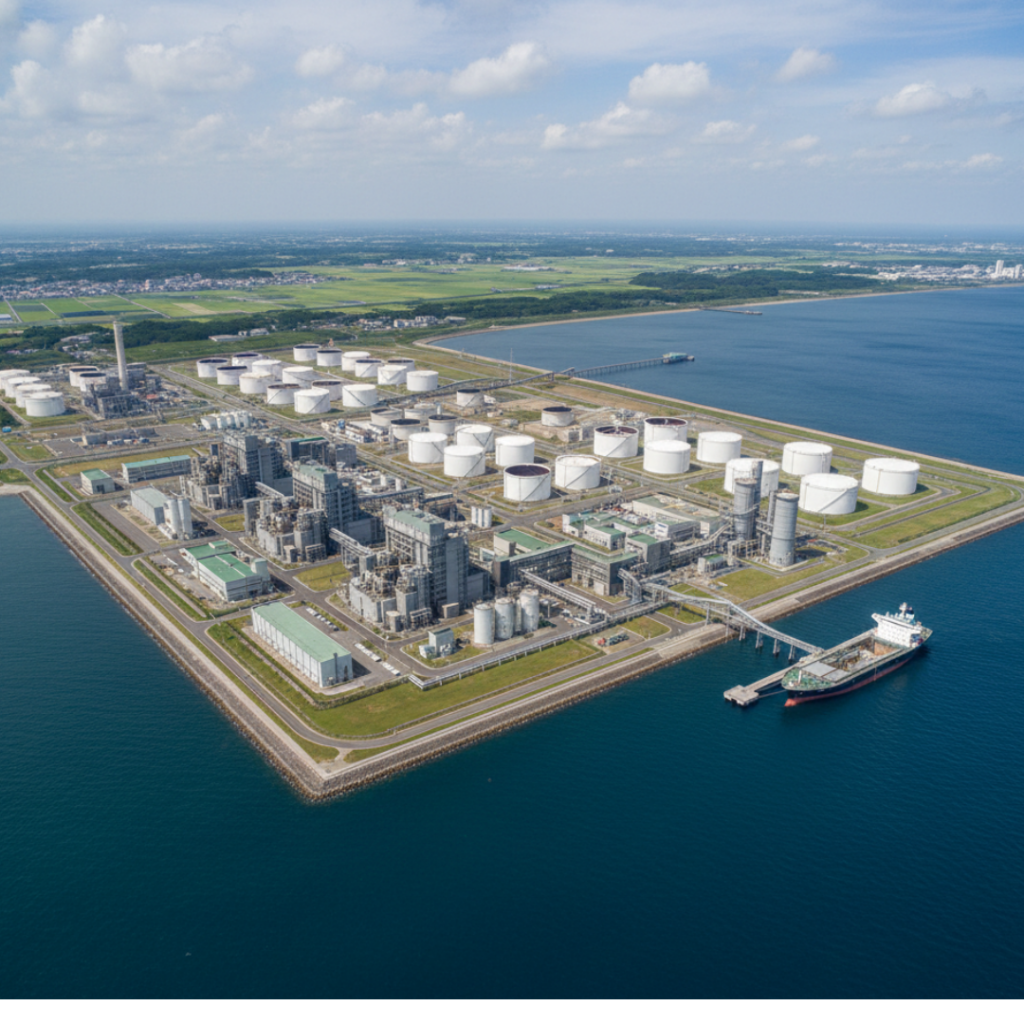
Niigata’s economic profile is shaped by energy infrastructure, logistics, and regional manufacturing. Developments related to the Kashiwazaki-Kariwa Nuclear Power Plant and renewable energy initiatives such as the Joetsu Biomass Power Station contribute to long-term employment clusters.
Large infrastructure ecosystems tend to produce:
- Stable professional employment
- Supporting service industries
- Consistent housing demand

At the same time, energy policy decisions remain subject to regulatory processes. and investors should monitor developments carefully. However, infrastructure-backed regions generally demonstrate steadier tenancy patterns than purely speculative locations.
Therefore, Niigata is not positioned as a high-growth market.
It is better understood as an infrastructure-supported regional hub where occupancy stability forms the core thesis.
Okinawa: Consumption and Regional Connectivity


Okinawa operates under a different economic mix. It benefits from:
- Strong domestic tourism
- Gradual visitor recovery
- Strategic location within Asia-Pacific trade routes
Institutions such as Okinawa Financial Group have articulated initiatives aimed at strengthening regional commercial and financial connectivity.
For investors, this may support:
- Urban residential demand in central Naha
- Select hospitality properties with disciplined underwriting
- Mixed-use assets aligned with transport hubs
Nevertheless,tourism-influenced markets require conservative occupancy modeling. Seasonal shifts and global travel patterns must be factored into cash-flow projections.
Selectivity is essential.
Interest Rates and Financing Conditions
A major concern for global investors is refinancing risk.
Compared with markets that experienced sharp post-pandemic price spikes, Japan’s property cycle has been more gradual. Leverage levels remain moderate, and financing structures are often predictable.
As interest rates normalize, Japan’s adjustments have been measured rather than abrupt.
For international portfolios, this can contribute to:
- Lower refinancing shock risk
- More predictable debt servicing
- Controlled yield movement
Japan does not eliminate rate risk.
It moderates volatility relative to more leveraged markets.
Regulatory Transparency and Long-Term Alignment
Recent revisions to inheritance-related valuation practices — often referred to as the “5-Year Rule” — have reduced short-term tax arbitrage strategies involving rental property acquired shortly before succession.
Under updated guidance, properties acquired within five years of inheritance may be assessed closer to acquisition value rather than heavily discounted metrics.
For long-term investors, this enhances:
- Regulatory transparency
- Policy clarity
- Alignment with genuine stewardship
Markets that discourage opportunistic tax engineering tend to reward disciplined ownership.
Risk Considerations: A Balanced View
Japan offers relative resilience — not immunity.
Investors should evaluate:
Demographics
Population decline remains a structural reality in parts of Japan. Asset selection should focus on regional hubs that attract surrounding migration and maintain employment bases.
Currency Exposure
Returns will be influenced by JPY fluctuations against HKD, SGD, USD, or AUD. Currency strategy must be integrated into overall portfolio planning.
Liquidity
Regional assets may require longer exit timelines than prime Tokyo properties. Investment horizons should reflect this reality.
Asset-Level Execution
Building condition, tenant quality, and management standards ultimately determine performance.
A credible strategy acknowledges these factors clearly.
Bridging Macro Stability and Local Execution
Macroeconomic reports provide direction.
Performance, however, is determined at the building level.
In Niigata, gradual infrastructure investment and steady tenancy trends reflect measured regional stability. In Okinawa, tourism recovery creates opportunity — but only when assets are selected conservatively.
For cross-border investors, the key challenge is translating macro optimism into disciplined underwriting.
That requires:
- Local knowledge
- Conservative assumptions
- Structured oversight
- Long-term perspective
Conclusion: Portfolio Construction, Not Speculation
Japan Real Estate Investment 2026 should be viewed through the lens of portfolio construction.
Japan’s comparative advantages include:
- Institutional transparency
- Domestic demand stability
- Measured policy adjustment
- Gradual market behavior
- Capital preservation
- Jurisdictional diversification
- Lower systemic volatility within Asia
select Japanese regional real estate can function as a stabilizing allocation within a broader global strategy.
The objective is not rapid expansion.
It is disciplined continuity.